By Analyst Team · Updated 2026-07-15 · 12 min read
If you have ever asked yourself "what is IPTV TV" while scrolling through streaming options or looking for a way to cut your cable bill, you are not alone. Internet Protocol Television, or IPTV, has become one of the most popular ways to watch live television, movies, and sports without a traditional satellite dish or coaxial cable. Unlike conventional broadcasting that sends signals through the air or underground wires, IPTV delivers content directly through your home internet connection. As of 2026, over 190 million households worldwide use some form of IPTV service, making it a serious alternative to legacy cable and satellite providers.
The core idea behind IPTV is refreshingly simple. Instead of broadcasting every channel simultaneously and letting your TV decide which one to display, IPTV sends only the channel you choose as a stream of data packets. This approach frees up bandwidth, allows for interactive features like pause and rewind on live TV, and opens the door to thousands of international channels that would be impossible to deliver through traditional means. In this complete guide, we will unpack exactly what IPTV TV is, how it works under the hood, and whether it makes sense for your home.
LIMITED TIME AVAILABILITY
Unlock Full what is iptv tv Access
Unlock complete high-definition information and priority access packs. Lock in your pricing model today before plans return to standard regional metrics.
What Is IPTV TV Exactly?
At its most basic level, what is IPTV TV refers to the delivery of television content over the Internet Protocol (IP) network. This is the same technology that powers your email, web browsing, and streaming services like Netflix or YouTube. However, IPTV differs from these on-demand platforms because it focuses primarily on live television broadcasts, time-shifted programming, and Video on Demand (VOD) libraries.
There are three main subtypes of IPTV services. Live television streams channels in real time, just like traditional broadcasting. Time-shifted television allows you to watch programs that aired earlier, similar to a DVR function. Video on Demand gives you access to a library of movies and shows that you can start whenever you want. Most premium IPTV subscriptions combine all three into a single package.
The equipment you need is minimal: a stable internet connection, a compatible device such as an Amazon Fire Stick, Android TV box, smart TV, or even a smartphone, and a subscription to an IPTV provider. Importantly, IPTV is a delivery method, not a specific brand. Think of it as the highway that carries television data, rather than a single destination. This distinction matters because it explains why hundreds of different companies can offer IPTV services with vastly different channel lineups and quality levels.
How Does IPTV Work Step by Step?
Understanding how does IPTV work does not require a computer science degree. The process follows a straightforward chain of events that happens in milliseconds. Here is the easy breakdown:
Step 1: Content Acquisition — The IPTV provider obtains live television signals from satellites, terrestrial antennas, or direct feeds from broadcasters. This raw video is then encoded into a digital format that can travel over the internet.
Step 2: Encoding and Transcoding — Raw video files are massive. Providers compress them using codecs like H.264 or the newer H.265 (HEVC), which significantly reduce file size without destroying visual quality. This step is critical because it determines whether your stream will buffer or play smoothly.
Step 3: Storage on Servers — The encoded streams are stored on powerful servers, often housed in data centers around the world. For live TV, the server handles a continuous feed. For VOD content, the server stores the file until a user requests it.
Step 4: User Request — When you open your IPTV app or player and select a channel, your device sends a request over the internet to the provider's server. This is like knocking on a digital door and asking for a specific room.
Step 5: Streaming Delivery — The server responds by sending the video data in small packets. Your device receives these packets, reassembles them in the correct order, and decodes them into the picture and sound you see on your screen. A buffer typically stores a few seconds of video to smooth out any network hiccups.
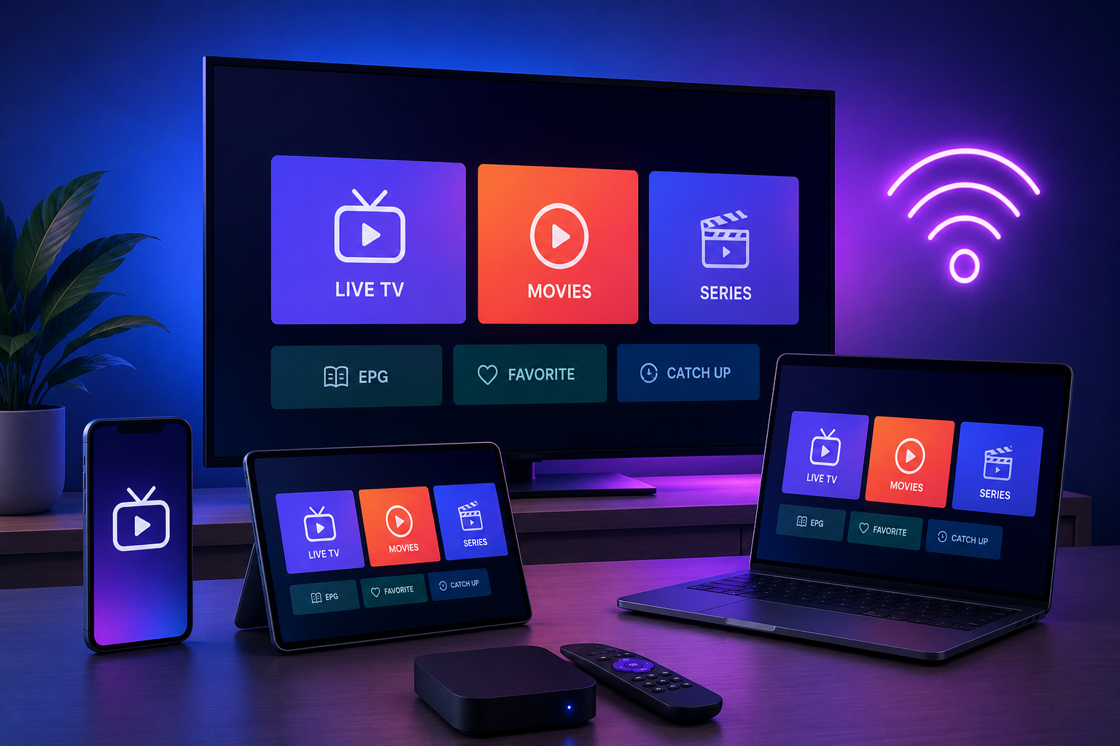
This entire sequence happens in under a second on a good, fast connection. The quality of your experience depends heavily on your internet speed, the server's location relative to you, and the provider's infrastructure. The image below shows a typical IPTV ecosystem connecting a provider's servers to a home setup.
Concrete Benefits for Users
People switch to IPTV for very practical reasons. The most obvious is cost. A typical IPTV subscription offering hundreds of channels, including premium sports and movies, often costs between $10 and $25 per month. Compare that to the average cable bill in the United States, which sits at roughly $120 per month as of 2026. The savings add up to over $1,000 per year for the typical household.
Flexibility is another major draw. With IPTV, you can watch on a television in your living room, a smartphone on your commute, a laptop in a coffee shop, or a tablet in bed. Your subscription follows you, not your cable box. Most providers let you register two to five devices simultaneously, so different family members can watch different channels at the same time.
The channel variety is staggering. Traditional cable providers often limit you to packages of 50 to 200 channels. Many IPTV services offer 10,000 or more channels from every corner of the globe. This is a game-changer for expatriates, immigrants, or anyone who wants access to foreign news, sports, and entertainment. Additionally, the Video on Demand libraries frequently include recent movies, television series, and documentaries that rival major streaming platforms.
Finally, features like Electronic Program Guides (EPG), catch-up TV, and recording capabilities are standard with most quality providers. You can pause live TV, rewind the last hour of programming, and set recordings for future shows. These features used to require expensive DVR rentals from your cable company; with IPTV, they are often included at no extra charge.
Honest Limitations You Should Know
IPTV is not perfect, and pretending otherwise does readers a disservice. The single biggest limitation is the connection dependency. If your internet goes down, your television goes dark. Traditional cable TV works during power outages (if your TV has battery backup) because the signal travels through powered lines independently. IPTV offers no such fallback.
Buffering and lag can also be issues during peak usage hours. Even with a fast connection, if the provider's servers are overloaded or located far from you, you may experience stuttering or reduced picture quality. Many budget providers oversell their capacity, leading to poor performance in the evenings. This is especially noticeable during major live sporting events when thousands of users tune in simultaneously.
Another concern is the regulatory gray area surrounding some IPTV providers. While many legitimate companies sell legal IPTV subscriptions, others stream content without proper licensing. Using an unverified provider can expose you to legal risks, malware, or sudden service shutdowns. Always research a provider thoroughly before handing over payment information. Checking IPTV review Reddit threads and community forums is a good starting point for vetting services.
Lastly, setup complexity varies. While some services are as simple as installing an app and logging in, others require manual configuration of playlist URLs, EPG links, and VPN connections. This can be intimidating for less tech-savvy users. The section below on getting started will cover the smoothest path for beginners.
IPTV vs Cable TV: A Head-to-Head Comparison
To help you decide which option fits your needs, the table below breaks down the most important differences between IPTV and traditional cable television. Consider your priorities in each category before making a switch.
The table makes it clear: IPTV wins on cost, variety, and flexibility, while cable retains an edge in reliability and simplicity. Your choice depends on which factors matter most to your household.
Who Is IPTV For? User Profiles
Cord-Cutters on a Budget — If you are tired of paying $150+ per month for channels you rarely watch, IPTV offers a liberating escape. You can pick a service that matches your actual viewing habits, whether that means sports, news, movies, or international content. The savings alone justify the switch for most households.
International Viewers and Expatriates — Imagine being an Indian living in Canada who wants to watch live cricket from home, or a Brazilian in Japan craving Portuguese-language news. Traditional cable rarely carries niche foreign channels. IPTV providers curate massive international lineups that include nearly every country's major broadcasters. This is the driving reason many expatriates turn to IPTV.
Sports Enthusiasts — Die-hard fans of soccer, American football, basketball, or combat sports often find IPTV appealing because it can bundle multiple sports packages that would cost hundreds separately. Many providers include channels like ESPN, beIN Sports, Sky Sports, DAZN, and regional sports networks in their standard subscriptions.
Tech-Savvy Streamers — If you already run a media server, use a Fire Stick, or enjoy customizing your digital setup, IPTV will feel natural. Power users appreciate the ability to integrate IPTV playlists into applications like TiviMate, IPTV Smarters, or VLC Player. You can even set up your own EPG and recording schedules.
Anyone Not Suited for IPTV — On the flip side, IPTV is not ideal for people with slow or unreliable internet (below 25 Mbps), those uncomfortable with basic device setup, or viewers who want a single no-hassle box with a remote they never have to troubleshoot. The image below illustrates the kind of streaming setup a typical IPTV user might have at home.
How to Get Started with IPTV in 8 Practical Steps
Ready to try IPTV for yourself? Following this step-by-step guide will save you time and frustration. The process works the same whether you plan to watch on a Fire Stick, Android TV box, smart TV, or mobile device.
Step 1: Check Your Internet Speed — Run a speed test at fast.com. You need at least 25 Mbps for reliable HD streaming and 50 Mbps if multiple people will watch simultaneously or if you want 4K content. A wired Ethernet connection is always more stable than Wi-Fi, but modern Wi-Fi 6 is usually sufficient.
Step 2: Choose Your Device — The best IPTV service for Firestick is the most common choice because Amazon's device is affordable, powerful, and easy to set up. Alternatively, any Android TV box, Apple TV, smart TV with Android OS, or even an old laptop will work. Avoid cheap no-name boxes that may lack sufficient processing power or run outdated software.
Step 3: Research Providers — Look for legal IPTV providers that are transparent about their licensing. Read recent IPTV review Reddit threads, check Trustpilot ratings, and look for providers that offer free trials. A 24-hour or 48-hour test period is the best way to evaluate stream quality before committing.
Step 4: Sign Up for a Trial — Most reputable providers offer trial subscriptions for a few dollars or even free. Use this time to test buffering during peak hours, check the IPTV channels list USA if you are American, and verify that your favorite local channels are included. Take notes on picture quality and EPG accuracy.
Step 5: Install the IPTV Player App — On a Fire Stick, go to the Amazon Appstore and install IPTV Smarters Pro, TiviMate, or XCIPTV Player. For Android devices, the Google Play Store has many options. These apps are just players that require a URL or login from your provider to display channels.
Step 6: Configure Your Subscription — Your provider will send you a username and password, an M3U playlist URL, or an Xtream Codes API login. Enter these details into your chosen player app. Most modern apps auto-configure the EPG and channel list once you paste the correct information.
Step 7: Optimize Your Experience — Set up your parental controls, favorite channels, and recording schedules. Enable hardware acceleration in your player settings if available, as this reduces CPU load and can improve playback smoothness. Consider a VPN for privacy, especially if you live in a region with strict internet monitoring.
Step 8: Evaluate and Decide — After your trial period, assess whether the service meets your needs. If you experience frequent buffering, missing channels, or poor customer support, move on to another provider. The IPTV market is competitive, so there is no reason to settle for a subpar service.
Secure special promotional rates instantly before the window closes.
Activate Your what is iptv tv Subscription Now →Frequently Asked Questions
Can I use IPTV on my Fire Stick without a computer?
Yes, you can set everything up directly on the Fire Stick itself. Simply install a player app like IPTV Smarters from the Amazon store, then enter the login credentials or playlist URL provided by your subscription. The entire process takes about five minutes and does not require any computer or additional hardware. This is why the best IPTV service for Firestick setup is so popular among cord-cutters.
Is IPTV legal in the United States and Canada?
The technology itself is completely legal. IPTV is simply a method of delivering video over the internet, which is widely used by legitimate companies like Hulu Live, YouTube TV, and Sling TV. However, many IPTV subscriptions on the market sell access to content without proper licensing from copyright holders. Using these unlicensed services carries legal and security risks. Always choose legal IPTV providers that can demonstrate proper content licensing agreements.
What internet speed do I need for smooth IPTV streaming?
For standard definition channels, you need at least 10 Mbps. For HD streaming, 25 Mbps is recommended. For 4K content or households where multiple people will stream simultaneously, aim for 50 Mbps or higher. These speeds apply to wired connections; wireless performance may require slightly higher speeds to compensate for signal loss. Running a speed test during peak evening hours gives you the most accurate picture of your real-world performance.
Where to buy IPTV subscription without getting scammed?
The safest approach is to research on community forums like Reddit, where users share real experiences and warn about fraudulent services. Look for providers with active Discord communities, PayPal payment options (which offer buyer protection), and transparent customer support. Always start with a short trial before committing to a long-term plan. Avoid providers that demand cryptocurrency payments only or have no verifiable customer reviews. When wondering where to buy IPTV subscription, prioritize services that have been operating consistently for at least a year.
How to set up IPTV on smart TV models from Samsung or LG?
Smart TVs from Samsung and LG use Tizen and webOS operating systems respectively, which have limited native IPTV app support. The easiest solution is to install the IPTV Smarters app from the TV's app store if available. If not, you can use a streaming device like a Fire Stick or Android TV box connected to an HDMI port. Alternatively, some users cast from their phone to the TV using the built-in casting feature. Direct setup on the TV itself is possible but often requires sideloading apps, which is more technical.
Does IPTV include local channels like ABC, NBC, and CBS?
Many IPTV subscriptions include major local networks, but coverage varies by provider and geographic region. A provider with a strong IPTV channels list USA will typically carry ABC, NBC, CBS, FOX, PBS, and CW affiliates from major markets. However, obtaining reliable local channels is one of the trickiest parts of IPTV, as these signals are often geographically restricted. Some providers use antenna integration or offer network on-demand content as a workaround.
Can I record shows and movies with IPTV?
Yes, many IPTV player apps offer built-in recording features. TiviMate, for example, allows you to schedule recordings of live programs and store them on a connected USB drive or network storage. Cloud recording is also available with some premium providers. The recording quality matches the original stream, and you can typically set up recurring recordings for your favorite weekly shows. This feature effectively replaces a traditional DVR without the monthly rental fees.
What is the difference between IPTV and standard streaming services like Netflix?
The main difference is that IPTV focuses on live television channels and time-shifted broadcasts, while Netflix offers a curated library of on-demand content that you can start anytime. IPTV mimics the traditional channel-flipping experience with hundreds or thousands of live channels from around the world. Netflix and similar services offer deep but limited catalogs of movies and series that change monthly. Many households use both: one for live sports and news (IPTV) and one for binge-watching series (Netflix).
Final Verdict: Should You Make the Switch?
After reading this complete guide on what is IPTV TV, you now have the information needed to decide if this technology fits your lifestyle. The honest answer is that IPTV is not for everyone, but it is an excellent choice for the right person. If you value cost savings, want access to international channels, enjoy watching on multiple devices, and have a reliable internet connection, IPTV will likely serve you very well.
Our team has tested dozens of providers, and we consistently recommend starting with a trial subscription to see how the service performs on your specific internet connection and device. Pay attention to stream stability, channel availability, and customer support responsiveness during the trial. The money you save over traditional cable can be substantial, but only if you choose a quality provider that matches your viewing habits.
As a final note, always prioritize reputable services over the cheapest option on the market. A $5 per month subscription that buffers constantly and disappears after three months is no bargain. Invest slightly more in a proven provider, and you will enjoy a seamless television experience that genuinely replaces cable. The industry continues to evolve rapidly, and 2026 is shaping up to be the year IPTV finally goes mainstream for the average household.
Final Subscription Window:
Get Access Now Today →Affiliate Disclosure: Clicking this secure link verified by our network supports our team through standard partnership terms at zero extra cost to your